Dark Matter Detectors Research
UIS Research Center
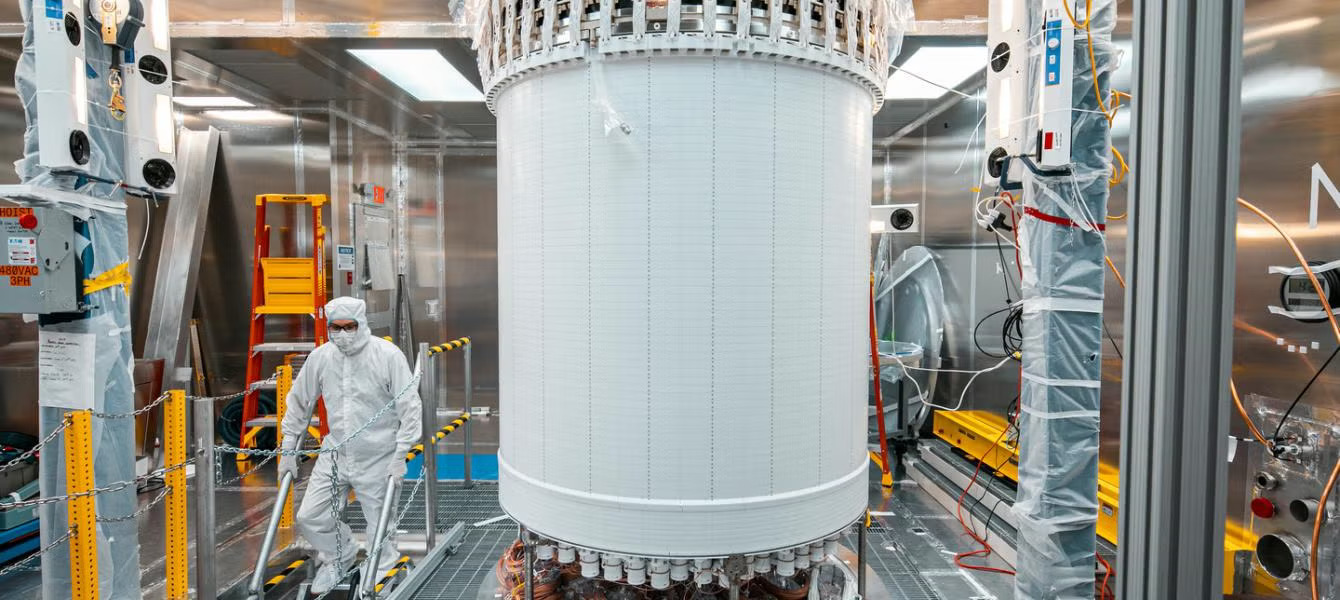
Selected among top 4 European students (out of ~600) for research on dark matter detectors using OTPC architecture. Simulated S1/S2 signal formation in OTPC detectors using GEANT4 (scintillation, electron drift, electroluminescence). Implemented and benchmarked End-to-End ML pipelines (RF, HGB, CNNs, Anomaly Transformers) achieving >93% accuracy in event classification. The project is currently ongoing and will be updated as progress is made.
Links
References / Inspired By
- J. Griffiths, S. Kleinegesse, D. Saunders, R. Taylor, A. VacheretElsevier (preprint) (2018) • arXiv:1807.06853This paper investigates the use of convolutional neural networks for neutron–gamma pulse shape discrimination using raw digitized scintillation waveforms. The CNN-based approach outperforms traditional charge integration and wavelet-based methods while learning physically interpretable features.
- LUX-ZEPLIN CollaborationAstroparticle Physics (Elsevier) (2020)This work presents the full Monte Carlo simulation framework used in the LUX-ZEPLIN experiment, enabling realistic modeling of signal and background events and validation of reconstruction and analysis pipelines.
- LUX-ZEPLIN CollaborationNuclear Instruments and Methods in Physics Research A (2019)This paper provides a comprehensive overview of the LUX-ZEPLIN dark matter experiment, including detector design, background mitigation strategies, and projected sensitivity to WIMP interactions.
- I. Parmaksiz, K. Mistry, E. Church, et al.arXiv (2025) • arXiv:2502.13215The paper evaluates GPU-accelerated optical photon transport using Opticks integrated with Geant4, demonstrating large performance gains for high-fidelity optical TPC simulations.
- P. Brás, F. Neves, A. Lindote, A. Cottle, M. I. Lopes, et al.European Physical Journal C (2022)This article presents a machine-learning-driven framework for classifying pulses in dual-phase xenon TPCs, combining clustering and supervised models to achieve high accuracy and robust anomaly detection.
- D. S. Akerib, X. Bai, J. J. Chapman, et al.Nuclear Instruments and Methods in Physics Research A (2011) • arXiv:1108.1836This paper describes the architecture and performance of the LUX data acquisition system, emphasizing low-noise waveform digitization and triggering strategies for rare-event detection.
- J. Aalbers, D. S. Akerib, A. Cottle, et al.Nuclear Instruments and Methods in Physics Research A (2024)This work details the fully digital acquisition and readout system developed for the LZ experiment, focusing on scalability, synchronization, and high-rate performance.
- I. J. M. HuanccoJournal of Physics: Conference Series (2018)This conference paper presents a Geant4-based simulation of a dual-phase argon TPC, focusing on scintillation, ionization, and PMT response for neutrino detection studies.
- Undergraduate Project ReportImperial College London (2019)This report compares traditional photon recognition techniques with CNN-based approaches using simulated and real PMT data, evaluating accuracy, robustness, and computational cost.